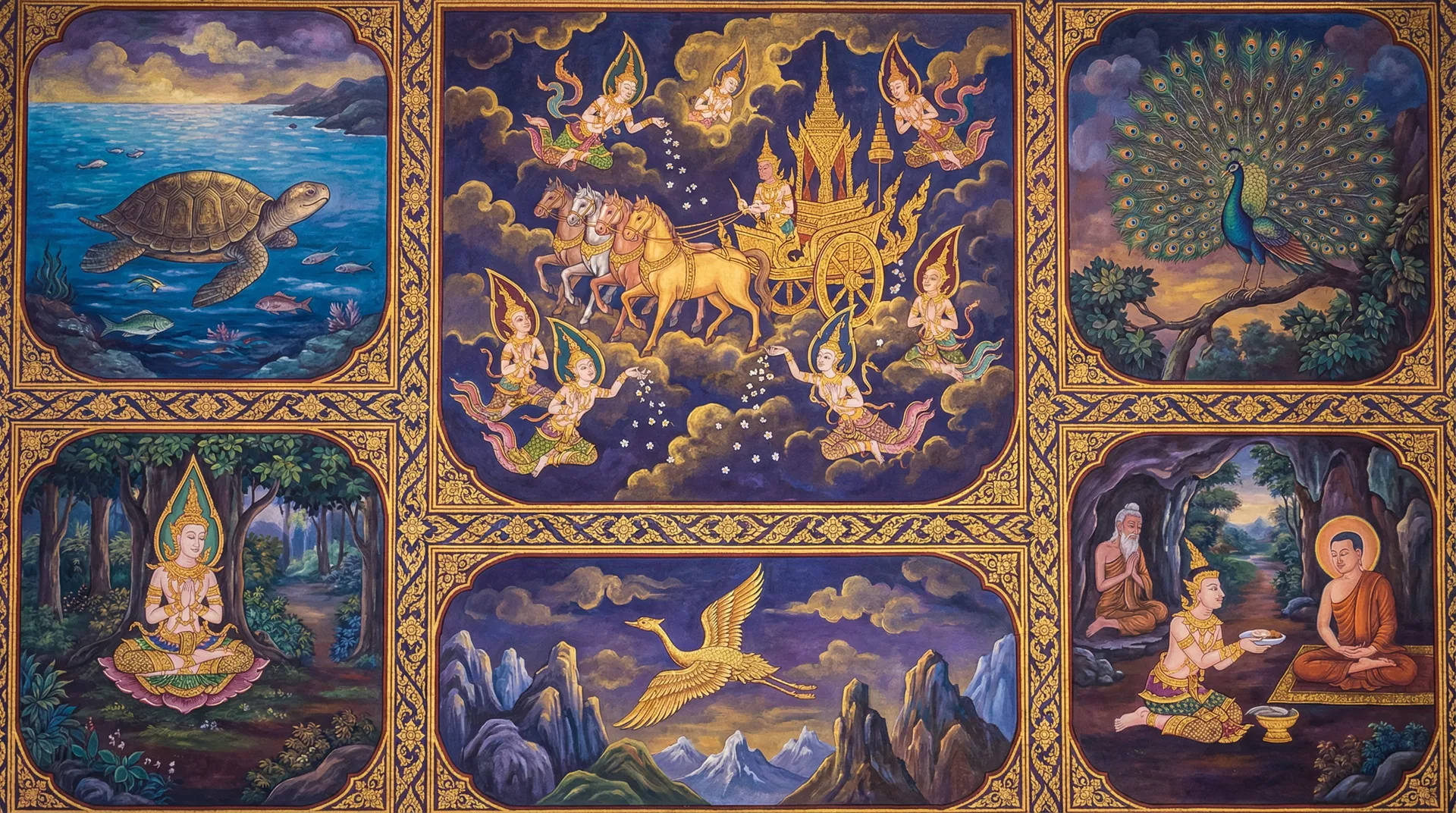
Mahosadha Jataka
Mahosadha Jataka
In the grand city of Mithila, capital of the Videha kingdom, ruled King Janaka, a benevolent monarch. Yet, even the wisest kings can benefit from astute counsel, and King Janaka was blessed with an advisor unlike any other: a young man named Mahosadha. Mahosadha was not born into royalty, nor did he hold a high office; he was simply a boy from a humble village, yet his intellect, foresight, and profound understanding of human nature were unparalleled. He was, in essence, the Bodhisatta in this life, destined to guide and protect the kingdom through his extraordinary wisdom.
The kingdom of Mithila often found itself entangled in complex disputes and faced threats from ambitious neighboring rulers. It was during these times that Mahosadha's brilliance truly shone. He possessed an uncanny ability to foresee consequences, devise ingenious solutions, and resolve intricate problems with remarkable ease.
One day, a neighboring king, named Viruddha, envious of Mithila's prosperity and King Janaka's wisdom, decided to test Mahosadha's intelligence. He sent a royal envoy with a peculiar challenge: a hundred pregnant cows were brought to Mithila, and the envoy declared, "Your Majesty, King Viruddha sends these cows as a gift. However, he has also decreed that each of these cows must give birth to a bull calf. If you can achieve this impossible feat, Mithila will be honored. If not, your kingdom will be humbled."
The court was thrown into a panic. The ministers and scholars debated endlessly, but no one could conceive of a way to fulfill such a preposterous demand. King Janaka, though perplexed, trusted in Mahosadha's wisdom. He summoned the young man.
Mahosadha, after hearing the challenge, smiled. "Your Majesty," he said calmly, "this is a test of intellect, not of magic. Tell the envoy that we accept the challenge, but we require a period of time and certain preparations."
Mahosadha then instructed his servants to gather a large quantity of the finest fodder, the most nutritious grains, and the purest water. He ensured that these provisions were made available to the hundred pregnant cows. He then devised a cunning plan. He had small, male calves, identical to those that would be born to the cows, prepared by skilled artisans. These calves were made of clay and meticulously painted to look as lifelike as possible.
When the time came for the envoy to return, Mahosadha approached him with a confident smile. "Your challenge has been met, noble envoy," he announced. "Go back to your king and tell him that Mithila has fulfilled his decree." He then presented the envoy with the hundred meticulously crafted clay bull calves, one for each of the pregnant cows. "These are the bull calves born to your cows," Mahosadha declared, gesturing to the perfect replicas.
The envoy was stunned. He had expected the king to fail, or perhaps attempt some futile, magical solution. He had never imagined such a clever and practical resolution. He examined the clay calves, marveling at their realism. He realized that Mahosadha had understood the true spirit of the challenge – to present a bull calf for each cow, thereby fulfilling the king's decree in a symbolic yet irrefutable manner.
When the envoy returned to King Viruddha and explained Mahosadha's ingenious solution, the neighboring king was not angry, but deeply impressed. He acknowledged Mahosadha's superior intellect and the wisdom of King Janaka for possessing such a brilliant advisor. He realized that attempting to outwit Mahosadha was a fool's errand and decided to abandon his hostile intentions, fostering instead a relationship of respect and admiration with Mithila.
On another occasion, a dispute arose between two merchants regarding ownership of a valuable jewel. Both claimed it was theirs, and their arguments were equally convincing. The case was brought before King Janaka, who, unable to discern the truth, turned to Mahosadha.
Mahosadha listened to both merchants' testimonies. He then asked for a pot of boiling water and a large basin. He instructed the merchants to place the jewel into the boiling water. One merchant, fearful for the jewel, hesitated, exclaiming, "No! It will be ruined!" The other merchant, however, remained silent and impassive, willing to risk the jewel.
Mahosadha immediately declared, "The jewel belongs to the one who fears for its destruction. He is its true owner." The merchant who had reacted with alarm confessed that he had indeed stolen the jewel from the other, fearing its loss. The true owner was thus identified, and the jewel returned to him.
Through countless such acts of wisdom, foresight, and cleverness, Mahosadha protected Mithila, resolved disputes, and guided King Janaka, ensuring the kingdom's peace and prosperity. His intelligence was not merely academic; it was a practical wisdom rooted in a deep understanding of people and situations, always employed for the welfare of others.
— In-Article Ad —
💡Moral of the Story
True wisdom lies not just in knowledge, but in the ability to apply it with cleverness, foresight, and a deep understanding of human nature to solve problems and bring about welfare for all.
Perfection: Wisdom (Prajna Paramita)
— Ad Space (728x90) —
More Jataka Tales You May Enjoy
 262Tikanipāta
Dhammapala Jataka
Dhammapala JatakaIn the ancient kingdom of Kosala, there lived a Bodhisattva who was destined to bec...
💡 Deception and malice can be overcome by truth, integrity, and unwavering virtue. Those who seek to harm others through falsehood will ultimately be exposed and defeated.
 457Ekādasanipāta
Dhamma-pāla Jātaka
Dhamma-pāla JātakaIn the celestial realm, where clouds of spun gold drifted across an endless sapphi...
💡 True strength lies in compassion, forgiveness, and adherence to righteousness, even in the face of adversity and betrayal.
281TikanipātaMahājanaka Jātaka
Mahājanaka JātakaIn the ancient city of Mithila, nestled beside the sacred river Aciravatī, reigned ...
💡 Even in the face of overwhelming adversity, perseverance and unwavering courage can lead to success. Never give up on your dreams, no matter how difficult the path may seem.
 354Pañcakanipāta
Phanasa Jataka
Phanasa Jataka In the ancient city of Ujjeni, lived a kind and virtuous Bodhisattva who was born as ...
💡 Integrity, unity, and perseverance are essential virtues, especially in times of hardship. Greed and selfishness lead to downfall.
 331Catukkanipāta
Mūgapakkha Jātaka
Mūgapakkha JātakaIn the sun-drenched land of Mithila, ruled a king named Brahmadatta, a monarch whos...
💡 True wisdom is revealed not through eloquent speech, but through careful observation, strategic patience, and decisive action.
287TikanipātaThe King of the Elephants (Makhādeva Jātaka)
The King of the Elephants (Makhādeva Jātaka) Long ago, in a lush forest teeming with life, a majesti...
💡 True leadership requires immense courage, self-sacrifice, and unwavering determination to protect and provide for one's followers, even in the face of insurmountable challenges.
— Multiplex Ad —